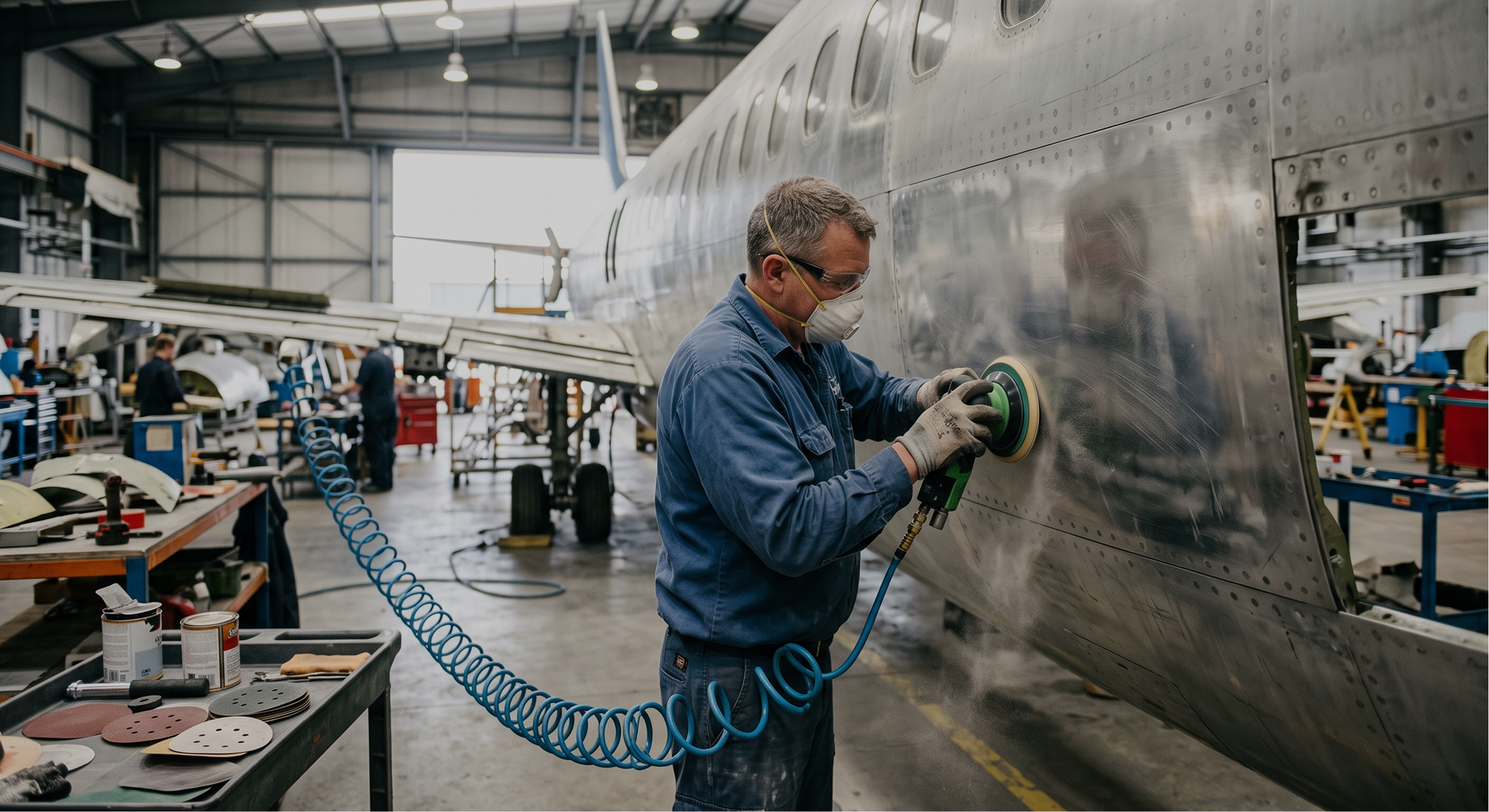
In aerospace, surface finishing is not a matter of appearance. Roughness, finish quality and surface defects affect a component's mechanical and fatigue strength, coating adhesion and aerodynamic behaviour. Yet in many shops, this step still relies on an operator and their experience.
On paper it looks like the cheapest option. In practice it is one of the hardest steps to measure in the entire production chain, and when you work with titanium alloys, carbon fibre composites or aluminium alloys, every uncontrolled variable comes at a price. Here are five costs that rarely show up in a quote, and what changes when finishing becomes a software-defined process.
1) Unpredictable cycle times on ever-changing parts.
In aerospace, batches are small and geometries change constantly: blades, airfoils, fairings, ducts, large panels. Every part comes with its own curvatures, fillets and hard-to-reach areas. By hand, two identical components never take the same time, and the extra minute spent on a leading edge becomes an hour lost by the end of the week.
Traditional automation struggles here too, because programming a robot for every new part takes hours that simply don't pay off at low volumes.
The result?
Broken schedules, batches waiting on the line, overtime. With Supero Finish, every cycle starts from a 3D scan of the actual part, in under 30 seconds. The operator draws the area to be processed on the digital model and the toolpath is generated automatically on the real geometry. New part, new scan, ready to go.
Stable cycle times, even when the production mix isn't.
2) Scrap on components that can't simply be remade.
A titanium alloy structural component, a composite panel, a compressor blade. None of these parts is cheap and none can be replaced quickly: between material, previous machining steps and lead times, by the time it reaches finishing its value is already very high.
By hand, that value depends on the operator's feel. A few seconds too long, a few newtons of extra force, and composite fibres end up exposed, more material is removed than necessary, or a groove is left behind that fails inspection.
Supero OS keeps force, speed, angle of attack and pad contact point constant along the entire path, even on the most complex surfaces. And before the robot even moves, the path is validated: collisions avoided, pad edge taken into account to prevent grooves, invalid segments highlighted in red. The entire cycle can be simulated offline on the digital twin.
An expensive part gets validated in simulation, not in production.
3) Consumables and dust nobody really measures.
Abrasive discs, pads, compounds. In manual finishing, more are used than necessary because uncertainty is always compensated the same way:
"One more pass, just to be safe."
Nobody measures pad wear, and the real finishing cost per part remains an estimate. In aerospace the problem extends to dust: composite dust is respirable, and titanium dust must be handled carefully due to the risk of combustion. Every unnecessary pass means more residue to extract, filter and dispose of.
With parameters defined for every path, and for every single repetition, finishing becomes progressive and measured: more aggressive passes at the start, finer ones at the end, no wasted passes.
When the process is defined, the cost per part becomes a number too.
4) Fatigue, vibration and downtime risk.
Sanding an aerospace component means hours of repetitive movements, vibration travelling up the arm, awkward postures to reach edges and undercuts, exposure to dust and coatings. Even without injuries, fatigue slows the work down and lowers concentration exactly where precision matters most.
With Supero Finish, the physical effort shifts to the robotic cell. The operator stays at the centre of the process, but their work becomes setup, supervision and quality control.
People decide. The system executes.
5) Quality and repeatability in the hands of a few.
Every shop has that technician who can "feel" when a leading edge is finished right. It's one of the most valuable profiles and one of the hardest to find, and their know-how takes years to pass on to someone else.
In an industry where every step must be documented and repeatable, a process that lives in someone's hands is also a process that's hard to describe, replicate and prove.
Supero OS turns that expertise into a digital workflow that stays with the company. Scanning, area definition, path generation and process parameters saved zone by zone become an asset that repeats the same way every time, regardless of who is using the system.
Manual sanding isn't cheap, it's just hard to measure. Once you factor in unstable cycle times, scrap on high-value parts, consumables, dust, fatigue and dependence on a few skilled people, the real cost far exceeds what was expected.
Supero Finish, integrated into Supero OS, takes aerospace surface finishing from a variable activity to a controlled, repeatable and documentable process, working with the robots already on your shop floor. From airfoils to multi-metre panels, from composites to titanium alloys, the goal stays the same:
More control. Less scrap. Higher productivity.
Download the guide "How to Map & Scan with Supero Finish" or contact our team to find out whether Supero Finish fits your components, materials and volumes.